

Spirit Distinctive Capabilities
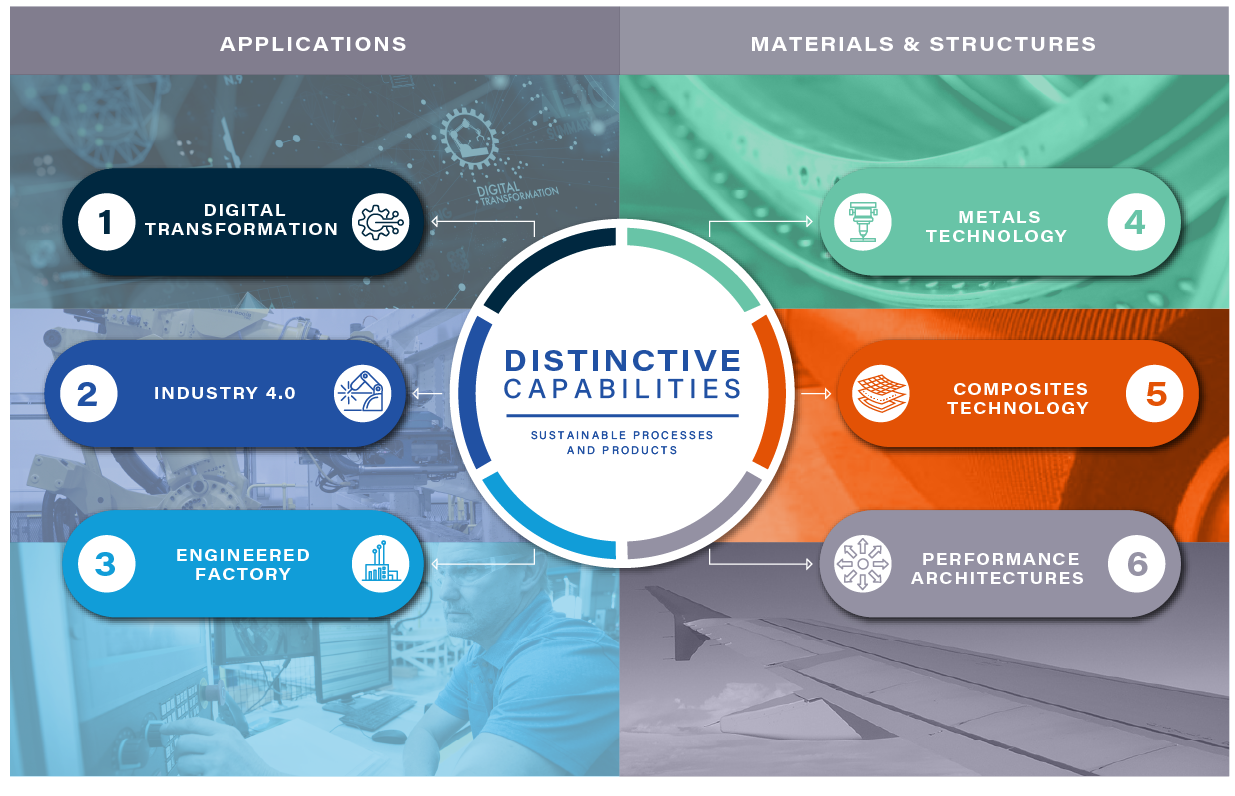
Spirit AeroSystems’ research and development team has identified six distinctive capabilities — major areas of technological advancement and innovation – that Spirit believes will define the aircraft of tomorrow. These innovative capabilities also help customers understand the value Spirit brings to the market, enabling success in both commercial and defense sectors.
How the Spirit’s Distinctive Capabilities Will Shape the Aircraft of the Future
Spirit AeroSystems has built a reputation as a global manufacturing powerhouse, and not without good reason.
Learn More
-
Digital Transformation
The software tools and concepts, from infrastructure (e.g., Office 365, GCC-High) through Spirit-originated (e.g., Spifi, Exact), and the digital tools with which we design and manufacture (e.g., SAS, KBE, MES, Spirit ONE), and sustain products – a cradle to grave approach, contributing to Industry 4.0. Also encompasses technologies such as AI, blockchain, dimensional simulation, operations simulation, etc.
-
Industry 4.0
The utilization of digital tools in our design, manufacture, and sustainment capabilities. Design for Manufacture (DfM) is soundly rooted here. This includes the use of automation, asset tracking, robotics, Integrated Internet of Things (IIoT), VR/XR/MR/AR, MES, MBSE and in the future, autonomous mobile robots, smart tools, etc. Industry 4.0 drives Engineered Factory.
-
Engineered Factory
The implementation of technologies into processes. The digitally-enabled engineered factory describes how digital tools drive efficiency up, and cost down. It is the use of DA/FSDA, metrology, reconfigurable/flexible tooling, ergo assessment, inspection methods, etc. to optimize design and manufacture on the floor. Engineered factory provides feedback to the Application Realm Process Loop.
-
Metals Technology
The materials, processes, evaluation, and improvement of metal technologies across our capability set. This includes machining, milling, drilling, joining, etc. of small through large components using traditional and future methods including additive manufacture, alternative joining (laser, ultrasonics, impact), and hard metals.
-
Composites Technology
The materials, processes, evaluation, and improvement of composite technologies across our capability set. This includes automated layup, allowables determination, thermoplastics, thermoset, high-temp (BMI, Polyimide, et.) and very high temp (C/C, C/SiC, Ox/Ox) and methods of joining, stitching, curing, etc.
-
Performance Architectures
The culmination of complex design and manufacture, using combinations of metal and composite technologies, to create laminar flow structures, aero structures, space structures, using modular systems architecture and novel approaches to bonding, testing, assembly, etc. Future adds include topology optimization, digital certification, etc.
Research and Technology: Global Technology Strategy
This comprehensive document outlines Spirit AeroSystems' portfolio of technologies and Distinctive Capabilities (DCs) across Applications and Materials & Structures realms. It details Spirit's strategic vision, technological advantages, and considerations for sustainability and industry factors that shape the global technology strategy.
Complete the form below to download.Explore More

© 2026 Spirit AeroSystems, Inc.