

Spirit AeroSystems Reports Second Quarter 2022 Results
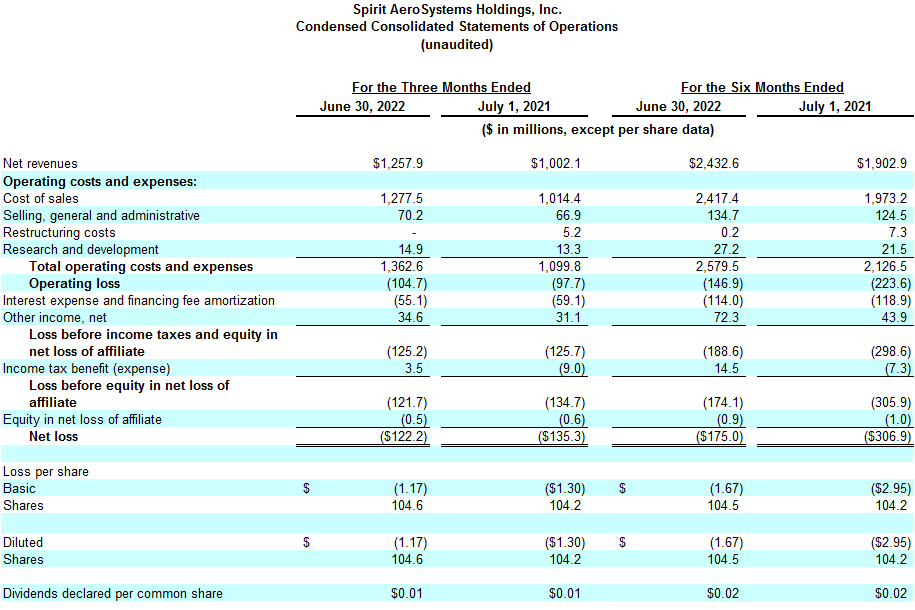
- Revenue of $1.3 billion, up 26% y/y
- EPS of $(1.17); Adjusted EPS* of $(1.21)
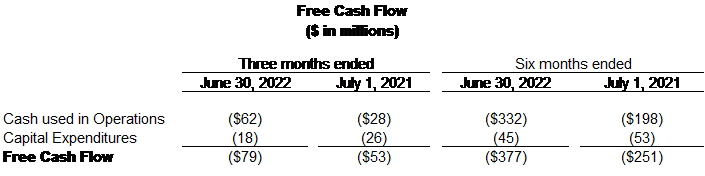
- Cash used in operations of $62 million; Free cash flow* usage of $79 million
Wichita, Kan., August 3, 2022 - Spirit AeroSystems Holdings, Inc. (NYSE: SPR) (“Spirit” or the “Company”) reported second quarter 2022 financial results.
“Like many other companies, this past quarter we experienced challenges with supply chain, staffing and inflation, as well as schedule changes from our customers, all of which put pressure on profitability,” said Tom Gentile, Spirit’s President and Chief Executive Officer.
“We remain focused on executing in our factories and meeting the commitments to our customers. Demand for aircraft remains robust but the expected slower increase in production rates should give us more time to stabilize the production system.”
Revenue
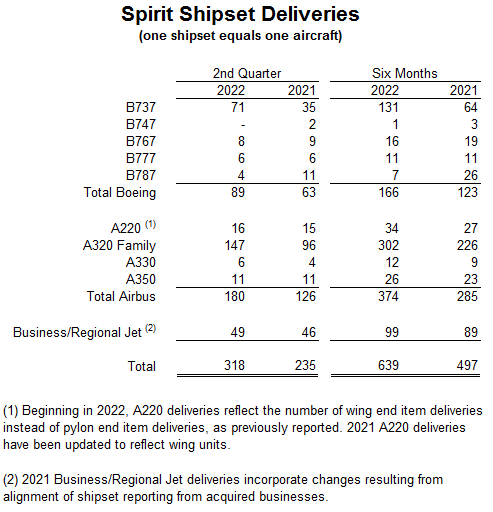
Spirit’s revenue in the second quarter of 2022 was $1.3 billion, up 26 percent from the same period of 2021. This increase was primarily due to higher production deliveries on the Boeing 737 program as well as increased Aftermarket revenue, partially offset by lower production volume on the Boeing 787 program. Overall deliveries increased to 318 shipsets during the second quarter of 2022 compared to 235 shipsets in the same period of 2021. This includes Boeing 737 deliveries of 71 shipsets compared to 35 shipsets in the same period of the prior year and Boeing 787 deliveries of 4 shipsets compared to 11 shipsets in the second quarter of 2021.
Spirit’s backlog at the end of the second quarter of 2022 was approximately $34 billion, with work packages on all commercial platforms in the Airbus and Boeing backlog.
Earnings
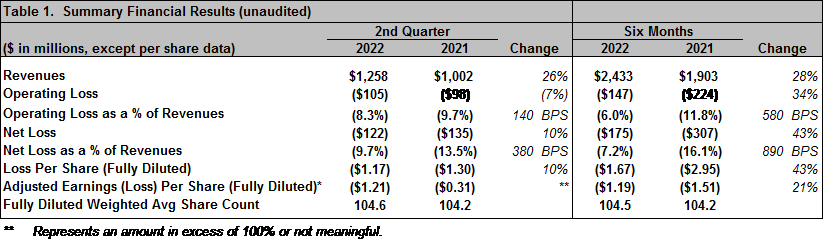
Operating loss for the second quarter of 2022 was $104.7 million, compared to operating loss of $97.7 million in the same period of 2021. This increase in operating loss was primarily driven by higher changes in estimates and losses related to Russia sanctions recorded during the second quarter of 2022, partially offset by higher production on the Boeing 737 program. Second quarter 2022 earnings included net forward loss charges of $63.7 million and unfavorable cumulative catch-up adjustments of $8.0 million. The forward losses relate primarily to the Boeing 787 and Airbus A220 programs. The forward loss on the Boeing 787 program is driven by the impact of production rate decreases and increased supply chain and other costs. The Airbus A220 program forward loss is associated with the bankruptcy of a supplier and costs to relocate the work. The unfavorable cumulative catch-up adjustments were primarily driven by schedule changes, parts shortages and increased estimates for supply chain, freight and other costs on the Boeing 737 and Airbus A320 programs. In relation to the sanctioned Russian business activities, Spirit recorded losses of $41.9 million as well as the reversal of a previously booked forward loss reserve of $13.8 million. Excess capacity costs recorded during the second quarter of 2022 were $44.9 million. In comparison, during the second quarter of 2021, Spirit recorded $52.2 million of net forward loss charges, favorable cumulative catch-up adjustments of $9.9 million, and excess capacity costs of $47.5 million.
Other income for the second quarter of 2022 was $34.6 million, compared to $31.1 million for the same period of 2021. The increase was primarily due to a gain of $20.7 million related to the settlement of the repayable investment agreement with the U.K. Department of Business, Energy and Industrial Strategy and higher foreign currency gains, partially offset by lower pension income, higher excise tax and losses on foreign currency forward contracts recognized during the second quarter of 2022.
Second quarter 2022 EPS was $(1.17), compared to $(1.30) in the same period of 2021. Second quarter 2022 adjusted EPS* was $(1.21), excluding the incremental deferred tax asset valuation allowance, settlement gain and losses related to Russia sanctions. During the same period of 2021, adjusted EPS* was $(0.31), which excluded restructuring costs and the incremental deferred tax asset valuation allowance. The decrease in adjusted EPS was primarily due to a discrete tax benefit in the second quarter of 2021 related to the change in U.K. corporate tax rates, as well as the required quarterly estimation of taxes in both years. (Table 1)
Cash
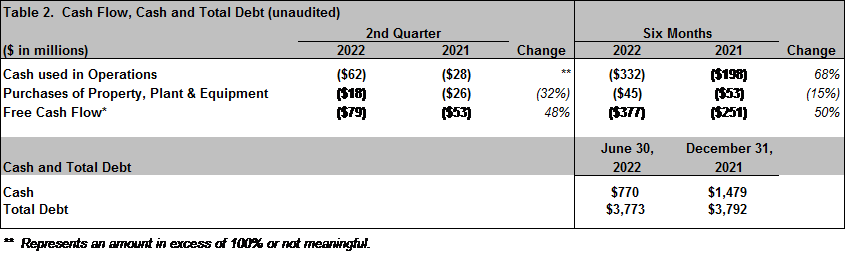
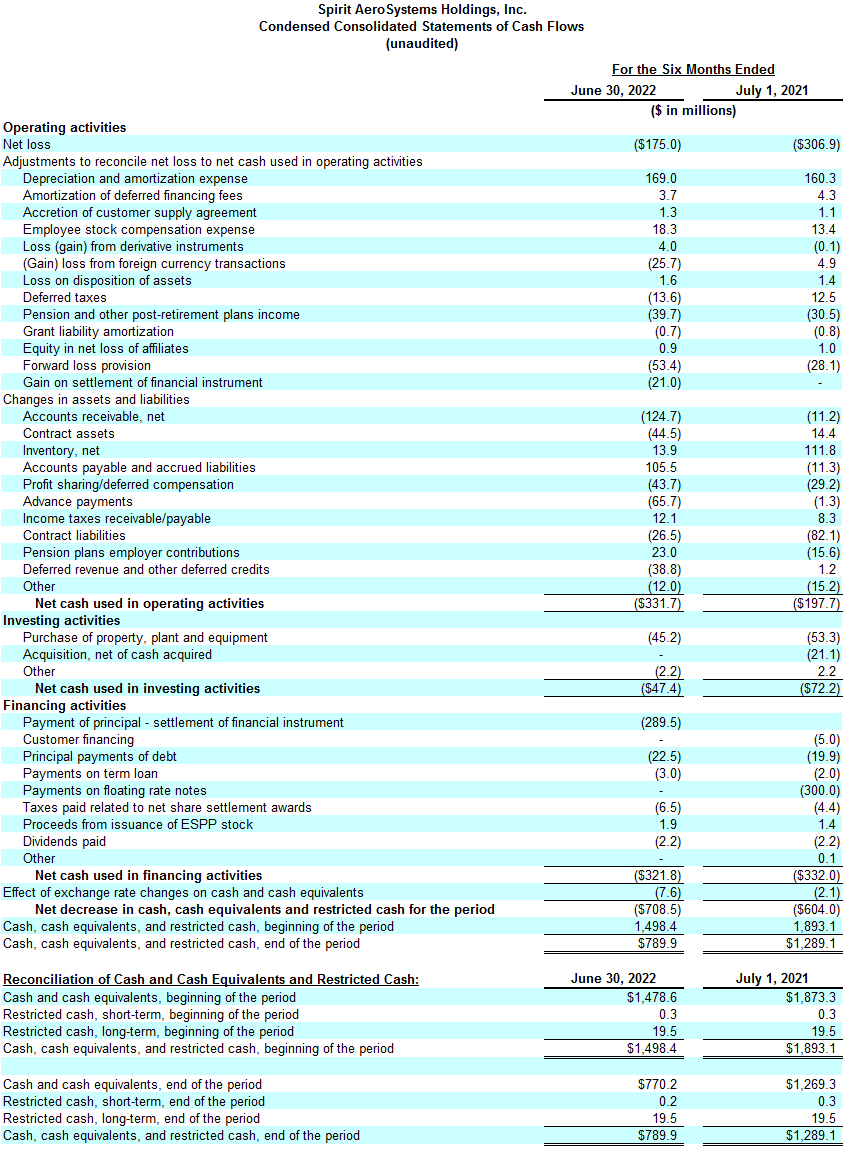
Cash used in operations in the second quarter of 2022 was $62 million, compared to $28 million of cash used in operations in the same quarter last year. This larger usage was primarily due to higher working capital resulting from increased production activities, the quarterly cash repayment of $31 million related to the Boeing 737 advance received in 2019 and the interest payment associated with the settlement of the repayable investment agreement. Additionally, during the second quarter of 2022, Spirit received the remaining balance of $24 million of the Aviation Manufacturing Jobs Protection (AMJP) program grant awarded in 2021 and $27 million of pension-related cash benefits, net of excise tax. Free cash flow* in the second quarter was a usage of $79 million, as compared to a free cash flow* usage of $53 million in the same period of 2021.
In April 2022, the Company settled the repayable investment agreement with the U.K. Department of Business, Energy and Industrial Strategy for a payment of $293 million. The payment is comprised of principal of $279 million and interest expense of $14 million, which are included in cash used in financing activities and cash used in operations, respectively.
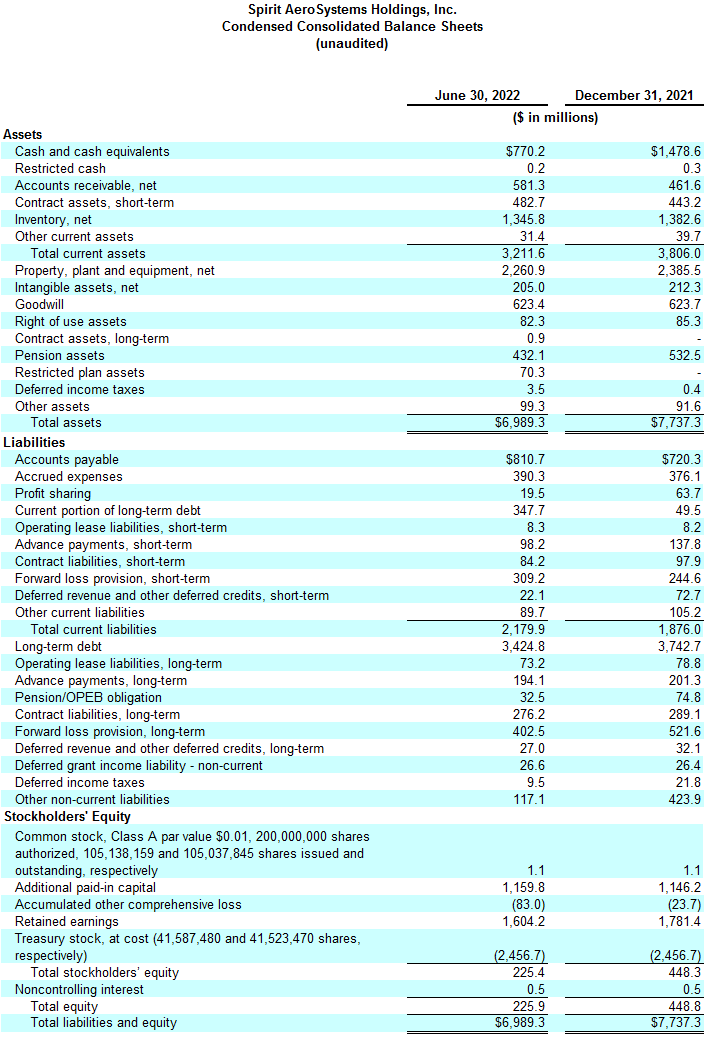
The cash balance at the end of the second quarter of 2022 was $770 million. (Table 2)
Segment Results
Commercial
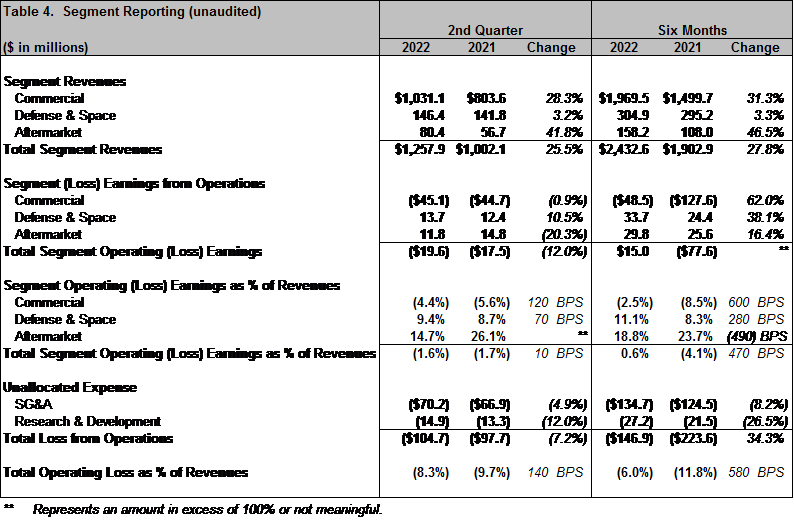
Commercial segment revenue in the second quarter of 2022 increased 28 percent from the same period of the prior year to $1.0 billion, primarily due to increased production revenues on the Boeing 737, 777 and Airbus A220 programs, partially offset by lower production volumes on the Boeing 787 and 747 programs. Operating margin for the second quarter of 2022 increased to (4) percent, compared to (6) percent during the same period of 2021. This improvement was primarily due to higher volumes on the Boeing 737 program and lower costs related to excess capacity and restructuring, partially offset by higher changes in estimates and losses related to Russia sanctions. In the second quarter of 2022, the segment recorded $59.4 million of net forward losses and $7.9 million of unfavorable cumulative catch-up adjustments. In relation to the sanctioned Russian business activities, the segment recorded losses of $37.7 million as well as the reversal of a previously booked forward loss reserve of $13.8 million. Additionally, during the second quarter of 2022, the Commercial segment included excess capacity costs of $43.1 million. In comparison, during the second quarter of 2021, the segment recognized $51.2 million of net forward losses, $10.5 million of favorable cumulative catch-up adjustments, excess capacity costs of $45.5 million and restructuring costs of $4.9 million.
Defense & Space
Defense & Space segment revenue in the second quarter of 2022 increased 3 percent from the same period of the prior year to $146.4 million, primarily due to increased production volumes on the Boeing P-8 program and higher development activity. Operating margin for the second quarter of 2022 was flat compared to the same period of 2021. The segment recorded excess capacity costs of $1.8 million and net forward losses of $4.3 million in the second quarter of 2022, compared to excess capacity costs of $2.0 million and net forward losses of $1.0 million in the second quarter of 2021.
Aftermarket
Aftermarket segment revenue in the second quarter of 2022 increased 42 percent from the same period of 2021 to $80.4 million, primarily due to higher spare part sales and maintenance, repair and overhaul (MRO) activity, compared to the same period in the prior year. Operating margin for the second quarter of 2022 decreased to 15 percent, compared to 26 percent during the same period of 2021, primarily due to losses of $4.2 million related to Russia sanctions.
Cautionary Statement Regarding Forward-Looking Statements
This press release contains “forward-looking statements” that may involve many risks and uncertainties. Forward-looking statements generally can be identified by the use of forward-looking terminology such as “aim,” “anticipate,” “believe,” “could,” “continue,” “estimate,” “expect,” “forecast,” “goal,” “intend,” “may,” “might,” “objective,” “plan,” “predict,” “project,” “should,” “target,” “will,” “would,” and other similar words, or phrases, or the negative thereof, unless the context requires otherwise. These statements reflect management’s current views with respect to future events and are subject to risks and uncertainties, both known and unknown. Our actual results may vary materially from those anticipated in forward-looking statements. We caution investors not to place undue reliance on any forward-looking statements.
Important factors that could cause actual results to differ materially from those reflected in such forward-looking statements and that should be considered in evaluating our outlook include, but are not limited to, the following:
- the impact of the COVID-19 pandemic on our business and operations, including on the demand for our and our customers’ products and services, on trade and transport restrictions, on the global aerospace supply chain, on our ability to retain the skilled work force necessary for production and development, and generally on our ability to effectively manage the impacts of the COVID-19 pandemic on our business operations;
- demand for our products and services and the general effect of economic or geopolitical conditions (including Russia’s invasion of Ukraine and the resultant sanctions being imposed in response to the conflict), or other events, such as pandemics, in the industries and markets in which we operate in the U.S. and globally;
- the timing and conditions surrounding the full worldwide return to service (including receiving the remaining regulatory approvals) of the B737 MAX, future demand for the aircraft, and any residual impacts of the B737 MAX grounding on production rates for the aircraft;
- our reliance on The Boeing Company (“Boeing”) and Airbus Group SE and its affiliates (collectively, “Airbus”) for a significant portion of our revenues;
- the business condition and liquidity of our customers and their ability to satisfy their contractual obligations to the Company;
- the certainty of our backlog, including the ability of customers to cancel or delay orders prior to shipment on short notice, and the potential impact of regulatory approvals of existing and derivative models;
- our ability to accurately estimate and manage performance, cost, margins, and revenue under our contracts, and the potential for additional forward losses on new and maturing programs;
- our accounting estimates for revenue and costs for our contracts and potential changes to those estimates;
- our ability to continue to grow and diversify our business, execute our growth strategy, and secure replacement programs, including our ability to enter into profitable supply arrangements with additional customers;
- the outcome of product warranty or defective product claims and the impact settlement of such claims may have on our accounting assumptions;
- our dependence on our suppliers, as well as the cost and availability of raw materials and purchased components, including increases in energy, freight, and other raw material costs as a result of the sanctions being imposed in response to Russia’s invasion of Ukraine;
- our ability and our suppliers’ ability to meet stringent delivery (including quality and timeliness) standards and accommodate changes in the build rates of aircraft, including the ability to staff appropriately for anticipated production volume increases;
- our ability to maintain continuing, uninterrupted production at our manufacturing facilities and our suppliers’ facilities;
- competitive conditions in the markets in which we operate, including in-sourcing by commercial aerospace original equipment manufacturers;
- our ability to successfully negotiate, or re-negotiate, future pricing under our supply agreements with Boeing, Airbus and other customers;
- our ability to effectively integrate the acquisition of select assets of Bombardier along with other acquisitions that we pursue, and generate synergies and other cost savings therefrom, while avoiding unexpected costs, charges, expenses, and adverse changes to business relationships and business disruptions;
- the possibility that our cash flows may not be adequate for our additional capital needs;
- any reduction in our credit ratings;
- our ability to access the capital markets to fund our liquidity needs, and the costs and terms of any additional financing;
- our ability to avoid or recover from cyber or other security attacks and other operations disruptions;
- legislative or regulatory actions, both domestic and foreign, impacting our operations, including the effect of changes in tax laws and rates and our ability to accurately calculate and estimate the effect of such changes;
- our ability to recruit and retain a critical mass of highly skilled employees;
- our relationships with the unions representing many of our employees, including our ability to successfully negotiate new agreements, and avoid labor disputes and work stoppages with respect to our union employees;
- spending by the U.S. and other governments on defense;
- pension plan assumptions and future contributions;
- the effectiveness of our internal control over financial reporting;
- the outcome or impact of ongoing or future litigation, arbitration, claims, and regulatory actions or investigations, including our exposure to potential product liability and warranty claims;
- adequacy of our insurance coverage;
- our ability to continue selling certain receivables through our supplier financing programs; and
- the risks of doing business internationally, including fluctuations in foreign currency exchange rates, impositions of tariffs or embargoes, trade restrictions, compliance with foreign laws, and domestic and foreign government policies.
These factors are not exhaustive and it is not possible for us to predict all factors that could cause actual results to differ materially from those reflected in our forward-looking statements. These factors speak only as of the date hereof, and new factors may emerge or changes to the foregoing factors may occur that could impact our business. As with any projection or forecast, these statements are inherently susceptible to uncertainty and changes in circumstances. Except to the extent required by law, we undertake no obligation to, and expressly disclaim any obligation to, publicly update or revise any forward-looking statements, whether as a result of new information, future events, or otherwise. You should review carefully the section captioned “Risk Factors” in the Company’s Annual Report on Form 10-K and the Company’s Quarterly Reports on Form 10-Q for a more complete discussion of these and other factors that may affect our business.
Appendix
In addition to reporting our financial information using U.S. Generally Accepted Accounting Principles (GAAP), management believes that certain non-GAAP measures (which are indicated by * in this report) provide investors with important perspectives into the company’s ongoing business performance. The non-GAAP measures we use in this report are (i) adjusted diluted earnings (loss) per share and (ii) free cash flow, which are described further below. The company does not intend for the information to be considered in isolation or as a substitute for the related GAAP measures. Other companies may define and calculate the measures differently than we do, limiting the usefulness of the measures for comparison with other companies.
Adjusted Diluted (Loss) Earnings Per Share. To provide additional transparency, we have disclosed non-GAAP adjusted diluted (loss) earnings per share (Adjusted EPS). This metric excludes various items that are not considered to be directly related to our operating performance. Management uses Adjusted EPS as a measure of business performance, and we believe this information is useful in providing period-to-period comparisons of our results. The most comparable GAAP measure is diluted earnings (loss) per share.
Free Cash Flow. Free Cash Flow is defined as GAAP cash provided by (used in) operating activities (also referred to herein as “cash from operations”), less capital expenditures for property, plant and equipment. Management believes Free Cash Flow provides investors with an important perspective on the cash available for stockholders, debt repayments including capital leases, and acquisitions after making the capital investments required to support ongoing business operations and long-term value creation. Free Cash Flow does not represent the residual cash flow available for discretionary expenditures as it excludes certain mandatory expenditures. The most comparable GAAP measure is cash provided by (used in) operating activities. Management uses Free Cash Flow as a measure to assess both business performance and overall liquidity.
The tables below provide reconciliations between the GAAP and non-GAAP measures.

Contact information:
Investor Relations: Ryan Avey or Aaron Hunt (316) 523-7040
Media: Chuck Cadena (316) 526-3910 or Haley Beattie +44 2895 680850
On the web: http://www.spiritaero.com